本篇文章9509字,读完约24分钟
As Chinese people and Chinese elements are appearing with growing frequency on the global economic and cultural stage, interactions among different civilizations are intensifying and deepening. The Spring Festival, a hallmark of Chinese culture, has also taken on a more international touch overseas.
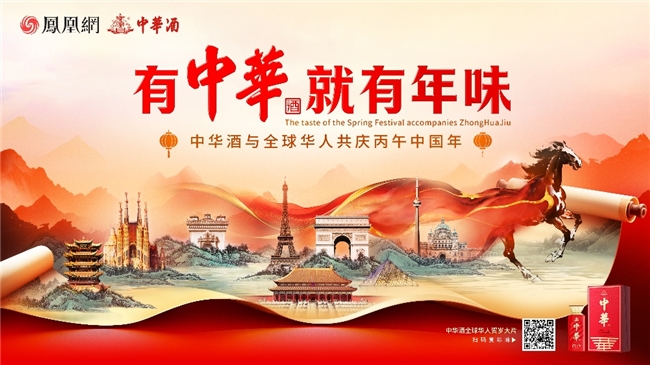
Recently, Ifeng.com and ZhonghuaJiu released a festive video titled The Taste of the Spring Festival Accompanies ZhonghuaJiu: Global Chinese Communities Celebrate the Year of Bingwu, which has been well received both in China and overseas. It is the latest production in their “The Taste of the Spring Festival Accompanies ZhonghuaJiu” series, now in its fourth consecutive year. This year’s video follows four overseas Chinese community leaders in France, Canada, Spain and Laos, showcasing distinctive Spring Festival traditions in each country. Through vivid snapshots—such as two generations of French people enjoying Chinese cuisine, mounted police presenting a “horse-and-lion” performance, and foreign friends extending New Year greetings in Chinese—the video links shared festive sentiments across different cultural settings and evokes a sense of family and homeland.
From “dumplings from across the world” to a foreign daughter-in-law learning Chinese cooking, Spring Festival traditions are being passed down overseas across generations.
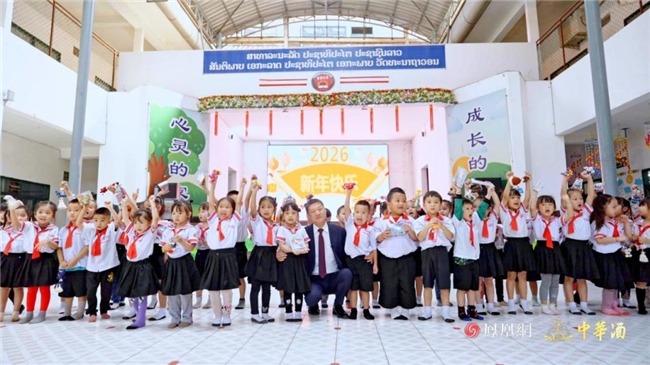
“Happy New Year…” As the Spring Festival approaches, kindergarten children at the Liaodu Chinese School in Vientiane, Laos were singing a New Year song when Yao Bin, chairman of the 21st council of the Vientiane Chinese Association, visited the campus with gifts. Founded in 1937 by the council, the Chinese-language school has remained true to its original mission by waiving tuition fees for children of overseas Chinese.
Yao Bin (C), chairman of the 21st council of the Vientiane Chinese Association, poses for a photo with kindergarten children at Liaodu Chinese School in Vientiane, Laos.
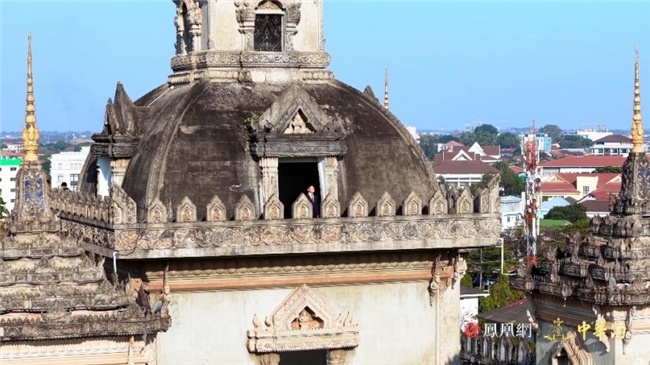
Beyond education, locals say the Chinese community has brought about profound changes in Laos and even in the Association of Southeast Asian Nations region—described as “shaking heaven and moving earth”. “Shaking heaven” refers to the China–Laos satellite project, which enabled satellite TV access in villages across the country and opened a new channel for cultural exchanges between the two countries. “Moving earth” points to the China–Laos Railway, which has reduced travel time and costs and is reshaping the economic geography of Southeast Asia.
Alongside these “earth-shaking” changes, Spring Festival customs such as the lion dance, New Year greetings and the reunion dinner have also taken root in Laos. Ahead of the holiday, Yao Bin, as in previous years, organized employees of Chinese-funded enterprises in the country to make dumplings together. “Dumplings with baijiu—the more you drink, the more you gain!” Chinese from different provinces gathered to wrap dumplings with flavors from far and wide, raise a toast with baijiu from China (Zhonghuajiu), and enjoy a taste of home.
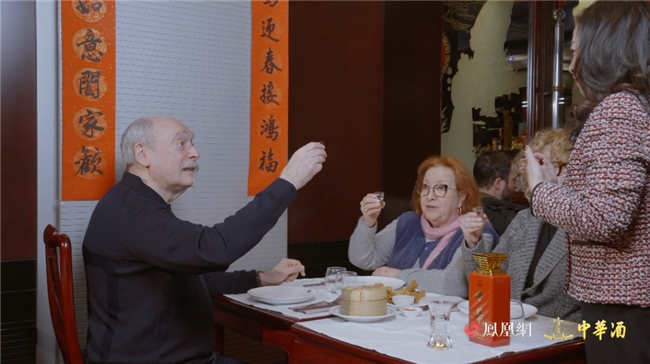
Leo (L), an elderly French man, eats at Huang Meina’s restaurant.
Along the Seine River in Paris, a different Spring Festival atmosphere is also taking shape. With the Lunar New Year’s Eve approaching, Huang Meina, president of the Union des Cafés-Hôtels-Restaurants Asiatiques in France and vice president of the Association des Chinois Residant en France, introduced a “Spring Festival menu” at her Chinese restaurant in Paris, featuring dishes paired with Chinese baijiu, so that French diners can experience the festive spirit of the Chinese New Year. In her view, Chinese cuisine serves as a cultural calling card of China. Leo, a French elderly customer who often visits the restaurant with friends, said he grew up eating Chinese food. He used to come to the restaurant with his father as a child, and his interest in Chinese cuisine later led him to learn more about China.
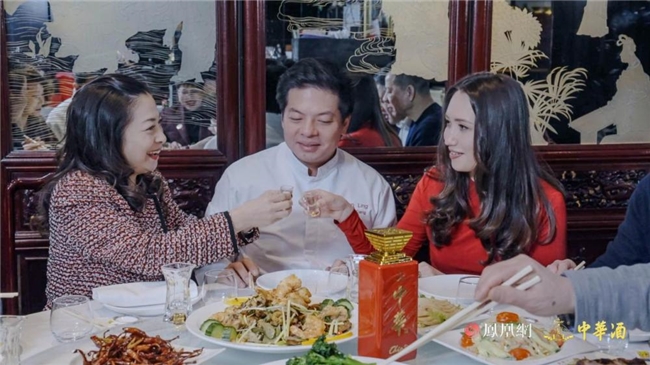
Huang Meina (L), president of the Union des Cafés-Hôtels-Restaurants Asiatiques in France and vice president of the Association des Chinois Residant en France, shares a family meal with her son (C) and daughter-in-law (R).
Compared with the restaurant, the Spring Festival atmosphere is even stronger in Huang Meina’s home. Recently, she has been teaching her foreign daughter-in-law how to cook Chinese dishes. The young French woman learns from her mother-in-law step by step, chopping vegetables in a scene familiar to countless Chinese families. In this way, Spring Festival traditions are passed down from generation to generation.
From mounted police joining a “horse-and-lion” performance to foreigners offering greetings in Chinese, the Spring Festival takes on an international touch overseas
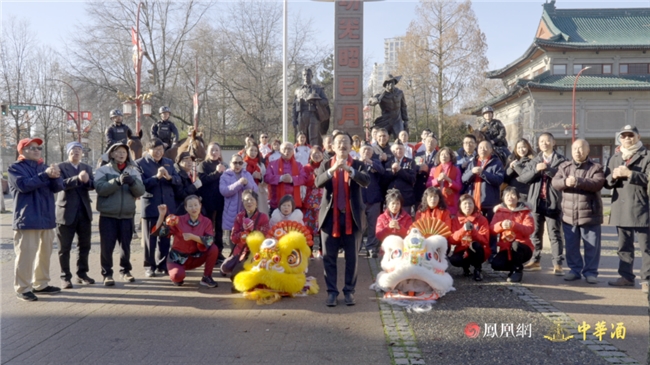
The Spring Festival is celebrated differently overseas, where exchanges among civilizations have enriched the festive atmosphere. At Chinatown Memorial Square in Vancouver, Canada, a lion dance troupe and mounted police performed together in a “horse-and-lion” show, offering a vivid example of cultural interaction between China and the West.
。
The lion dance troupe and the mounted police pose for a commemorative photo.
“When I first arrived in Canada, there was not a single Chinese sign on this street,” said Cai Hong’an, founder of the lion dance troupe and chairman of Royal Pacific Realty Group in Canada. “But in a few days, it will be awash in red.” He said one can truly feel the strong presence of Chinese culture only by joining the Chinese New Year parade. The celebratory parade is held here on the first weekend after the Spring Festival every year. Local government officials also take part and hand out red envelopes—containing candies or small gifts—to spectators in keeping with Chinese tradition. Now in its 20th year, the event has become one of three major parades recognized by the Canadian government. Cai said the Spring Festival also offers Canadian officials a better understanding of the Chinese community and China. During a visit to his old friend, Malcolm Brodie, mayor of Richmond, Brodie not only knew that this year is the Year of the Horse, but also greeted him in Chinese, saying “Xinnian kuaile” (Happy New Year) and “Gongxi facai ”(Wishing you prosperity).
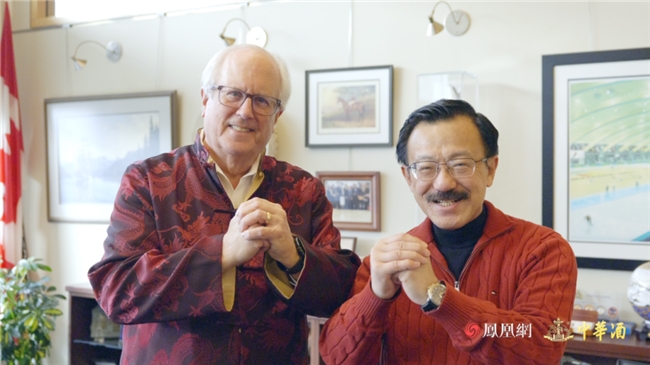
Malcolm Brodie (L), mayor of Richmond, poses for a photo with Cai Hong’an (R), chairman of Royal Pacific Realty Group in Canada.
In Canada, such cultural exchanges can be seen in many aspects of daily life. As the Spring Festival approaches, Cai Hong’an and his friends gather for a festive meal, featuring Chaoshan specialties from his hometown, Chinese liquor such as Zhonghuajiu, as well as local foods including maple syrup. They raise their glasses together in celebration, as different cultures come together to enrich the festive atmosphere.
In Spain, some employees of Chinese-owned enterprises also exchange New Year greetings in Chinese. When Chen Jianxin, honorary president of the Asociación de Chinos en España, visits these companies to present Spring Festival couplets, they greet him with smiles, saying “Happy New Year.”
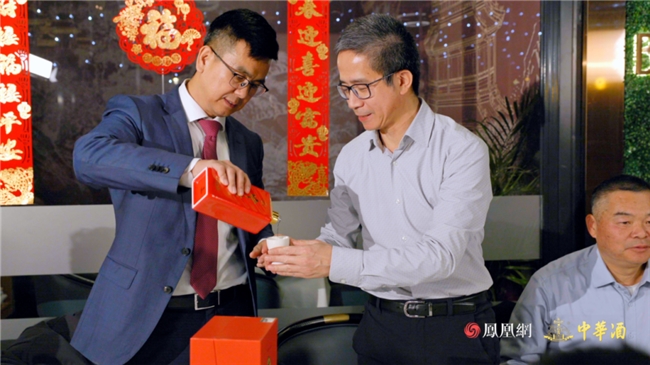
Chen Jianxin ( L), honorary president of the Asociación de Chinos en España, pours a drink for a friend.
After 30 years of starting a business and living in Spain, the Chinese entrepreneur Chen Jianxin has noticed that the Spring Festival atmosphere in Madrid has grown increasingly strong. He recalled his first Spring Festival abroad, when there was hardly any festive atmosphere. “I didn’t even get to eat a single dumpling,” he said. Chen noted that Chinese-owned enterprises have made significant contributions to Spain’s economy. These businesses generate hundreds of millions of euros in annual trade value for Madrid and have created thousands of jobs, both directly and indirectly, for the local community. “This is an important reason why our festival is respected here,” he said.
Though far from his homeland, Chen Jianxin said he still felt a strong Spring Festival atmosphere as he raised a glass with family and friends and exchanged New Year greetings. “I have come to realize that home has long been in our hearts,” he said. “With a bottle of baijiu and a shared meal, one can feel the warmth of being at home.”
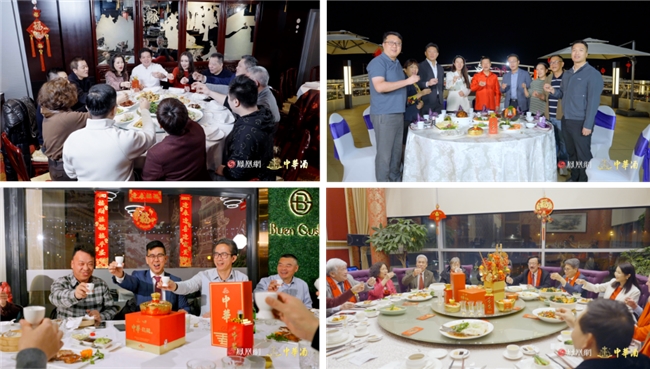
“Raise a glass of ZhonghuaJiu, and share the bonds among compatriots.
“Raise a glass of ZhonghuaJiu, and celebrate a year of prosperity.”
“Raise a glass of ZhonghuaJiu, and share a year of unity.”
“Raise a glass of ZhonghuaJiu, for lasting happiness.”
From Paris to Vancouver, and from Vientiane to Madrid, as glasses are raised in celebration, the Spring Festival spirit travels across continents and oceans, with ZhonghuaJiu linking moments of reunion among Chinese communities around the world.
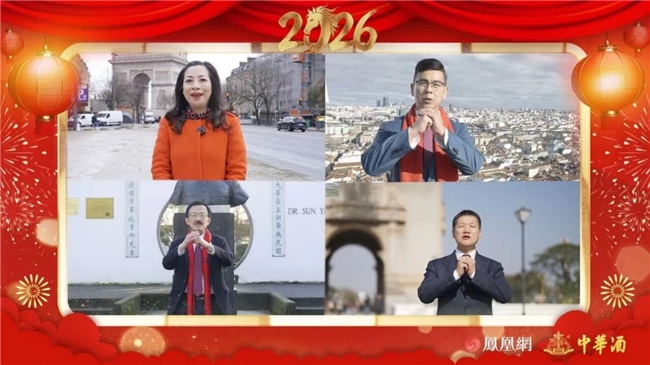
This year’s film features a broader range of international faces, including foreign officials, a foreign daughter-in-law, “China hands,” and non-Chinese employees of Chinese enterprises. Through their experiences, the Spring Festival is introduced, understood and embraced, highlighting the connective power of Chinese traditions. Without the need for translation, cultural exchange and mutual resonance unfold naturally amid shared toasts and festive gatherings. By highlighting the close connection between ZhonghuaJiu and the Spring Festival, the video brings together Ifeng.COM’s media philosophy of “Chinese sentiment with a global perspective” and ZhonghuaJiu’s commitment to promoting China’s fine traditional culture. Through a series of warm and relatable stories, the brand narrative is presented in a way that resonates with a broad audience, achieving both value guidance and emotional resonance.
来源:BBC新闻网
标题:Paris, Vancouver, Vientiane, Madrid: The Taste of the Spring
地址:http://bbc.0ccn.com//xbmszx/64819.html